Explainer
Shikibuton vs Futon: Why They Are Not the Same Product
The word futon covers two unrelated products in English: a 2 to 4 inch Japanese floor mattress and a 6 to 10 inch Western sofa bed. Here is how to tell them apart and buy the right one.
Updated November 18, 2026 · Based on 8 sources · How we research
If you have ever typed "futon" into a search bar and seen both a $120 roll-up floor mattress and a $600 wood-framed sofa bed in the same results, you have met the problem this guide exists to solve. In English, the word futon has been attached to two products that share almost nothing in construction, thickness, or purpose. One is the shikibuton, a 2 to 4 inch cotton floor mattress that Japan has used for centuries. The other is a 6 to 10 inch Western convertible mattress designed by Boston furniture maker William Brouwer in the mid 1970s to sit on a bifold wooden frame. Shoppers who do not know the difference end up with the wrong product in the wrong room, and the mistake is expensive in both directions. This explainer is for anyone trying to figure out which one they actually want before they buy.
Two completely different products, one word
In Japanese, futon (布団) is an umbrella term for the whole bedding set: the shikibuton is the thin floor mattress you sleep on, the kakebuton is the quilted comforter on top, and the makura is the pillow. The piece most Western shoppers actually want when they say "Japanese futon" is the shikibuton. Kyoto maker Takaokaya builds its shikibutons to approximately 10 cm (3.9 inches) when new, with cotton layered by hand and held in place by watoji hand-stitching rather than machine quilting (Takaokaya Kyoto). Soaring Heart puts typical loft at 3 to 4 inches and notes the fundamental point: the shikibuton is designed to be used on the floor and put away each morning, which is why the profile is thin enough to fold (Soaring Heart Natural Bed Company).
In English, "futon" means something else entirely. The product most American and British retailers sell under that name is a 6 to 10 inch mattress of polyfoam, polyester and cotton batting that sits on a hinged wood or metal bifold frame and converts between a sofa and a bed. Mattress Nut's comparison places the shikibuton at 2 to 3 inches of compressed cotton laid directly onto a tatami mat or clean floor, and the Western futon mattress at 6 to 10 inches on a slatted frame that converts from sofa to bed (Mattress Nut). The two share a name, nothing else.
What a shikibuton actually is
A traditional shikibuton is a hand-stuffed pad of layered cotton batting inside a cotton cover, quilted or tufted so the fill does not migrate. Takaokaya notes that its handmade cotton shikibutons compress to roughly half of their original height as the batting settles over time, which is why Japanese owners re-fluff or re-pack the cotton rather than replace the whole thing (Takaokaya Kyoto). The thinness is not a cost-cutting choice. It is the point. The cotton gives, the floor below does not, and the sleeper rests on a surface that is firm because it is a surface, not because of layered foams.
The shikibuton has to be aired. Soaring Heart describes the traditional routine: shikibutons were created to be used on the floor and picked up every day (Soaring Heart). J-Life's care page recommends sunning the futon once every 1 to 2 weeks for about 2 hours per side if it sits directly on the floor, is used often, or lives in a humid environment, because cotton pads trap moisture from body heat and perspiration and can develop mold without airing (J-Life International).
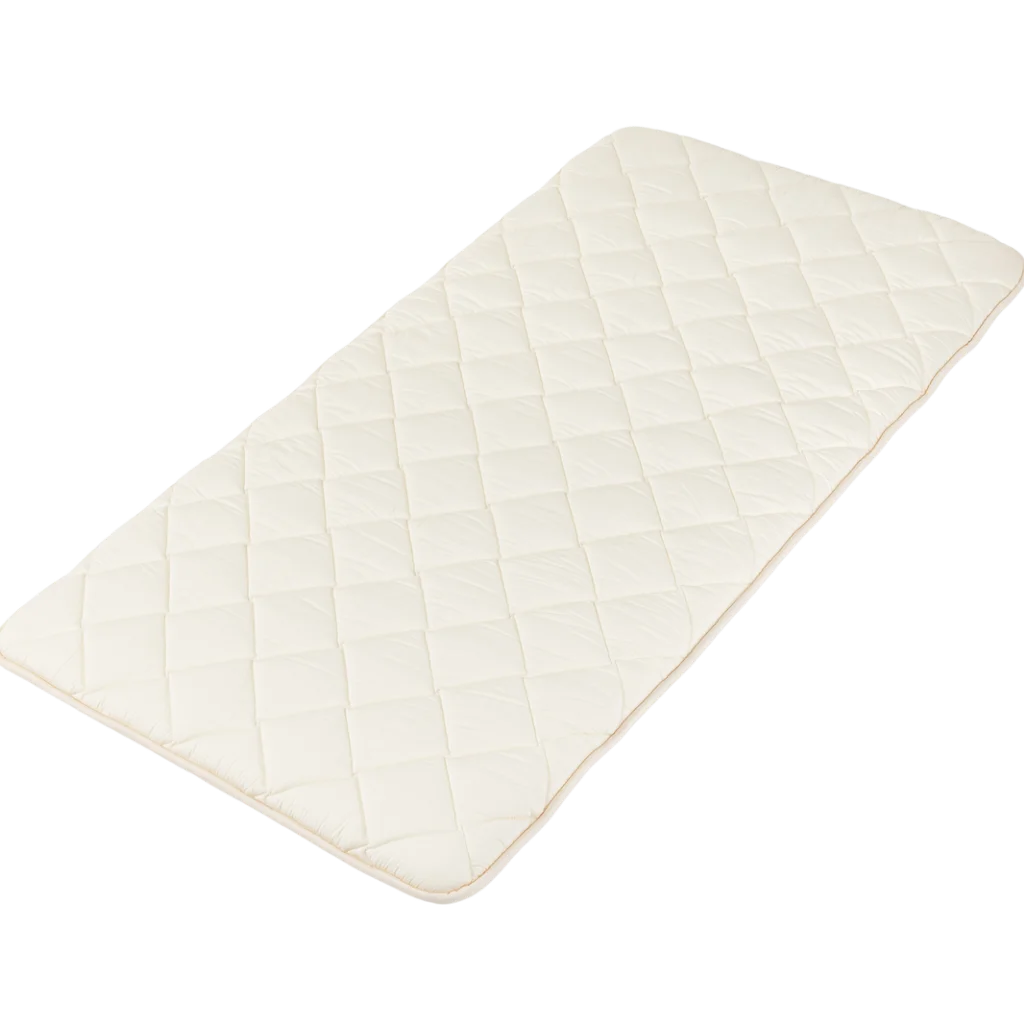
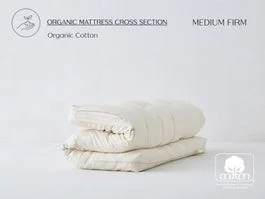
In our 2026 ranking, the products that match this definition are the ones built from dense cotton batting in a cotton or silk cover with a trifold or roll-up format: the J-Life Shikifuton with Shiruku Silk Snow Cover at 3 inches, the FULI Japanese Futon King Size White at 2.5 inches, and the FULI Traditional Japanese Shikibuton at 3 inches. The Futon Shop Traditional Organic Cotton at 5 inches and 29.5 pounds is still a shikibuton, but it sits at the heavy end of the category.
What the Western futon actually is, and when it got the name
The product sold in the United States as a "futon mattress" is a 1970s invention. Japan Objects attributes the Western-style design to Boston furniture maker William Brouwer, who in the 1970s designed a three-part wooden frame to service the small apartments people lived in. His design held a mattress thicker and softer than the Japanese original, built from shorter, curlier, cheaper cotton layers placed on the wooden slats of a sofa-bed (Japan Objects, Tokyo Weekender). Wikipedia notes that futons became fashionable in North America in the mid-1970s (Wikipedia).
The mattress built for that frame is a very different object. Typical Western futon mattresses are 6 to 9 inches thick with a polyfoam or polyester core wrapped in cotton batting and sized to standard North American bed dimensions. They are stitched to flex at the fold line but to stay roughly in shape when flat. They are not rolled or trifolded daily. They sit on the slatted frame that converts from sofa to bed and back, and the frame carries the weight. Sleep Sage's survey of the category describes 6 to 8 inches as the balanced range for a bifold frame and 8 to 10 inches as primary-bed territory that is stiff to fold and hard on frame hardware (Sleep Sage).
The naming is a historical accident. Brouwer's design drew on Japanese cotton batting, so his product kept the Japanese word, and the word stuck across an entire category that then evolved into foam-core sofa beds. English-language retailers never adopted a separate term for the Western product. That is the whole reason this guide has to exist.
They do not substitute for each other in either direction
Putting a shikibuton on a Western futon frame defeats the shikibuton. A 2 to 3 inch cotton pad on a slatted bifold is a pad on slats: the firmness that comes from the floor underneath is gone, and the thinness that makes a shikibuton work has nothing solid to work against. The shikibuton is built for a surface that does not give. A slatted frame gives.
Going the other direction is worse. A 6 to 10 inch Western futon mattress on the floor will not trifold, and the sun-airing routine that keeps a cotton shikibuton dry is physically impractical with a 10 inch foam-core mattress. Cotton shikibutons breathe because they are thin and the fill is hygroscopic, which is why J-Life's care page specifically calls out floor placement and humid environments as reasons to sun a cotton futon more often (J-Life International). A foam core does not shed moisture the same way, and daily folding, the care practice that keeps a shikibuton alive, is not feasible with a thick convertible mattress.
The practical rule is the one the construction implies. If the product is 2 to 4 inches of cotton batting in a cotton cover with a roll-up or trifold format, it is for the floor. If it is 6 to 10 inches of foam and batting stitched for a bifold frame, it is for a frame. A product between those two heights, typically 4 to 6 inches with a foam core, is a hybrid floor pad that compromises on both ends, and most of those live in the category we rank as Japanese Floor Mattresses rather than as sofa-bed mattresses.
| Trait | Shikibuton | Western futon mattress |
|---|---|---|
| Thickness | 2 to 4 inches (rarely 5) | 6 to 10 inches |
| Fill | Cotton batting, sometimes wool or latex | Polyfoam core wrapped in cotton or polyester batting |
| Where it goes | Direct on tatami, wood or firm foundation | On a hinged wood or metal bifold frame |
| Daily use | Folded or rolled and stored each morning | Stays on the frame, folds up as a sofa |
| Airing | Essential, sun-aired regularly | Not required |
Why your futon mattress is "too thick to fold up"
If you bought something marketed as a futon and now realize it will not roll or trifold easily, you almost certainly have a Western sofa-bed mattress or a foam-core hybrid, not a shikibuton. In our data, a 3-inch cotton shikibuton like the J-Life Shikifuton with Jumbo Seika Ha Green rolls to roughly a 20-inch diameter at queen size. The MAXYOYO 6-Inch Extra Thick technically trifolds, but the resulting block is listed at about 18 inches tall, and a true Western futon mattress is designed to hinge once as a sofa, not to trifold for closet storage.
The second common cause is foam content. Cotton compresses and rebounds. Polyurethane foam resists compression and pushes back against straps. Products like the FULI Premium Wavy Foam Core or the EMOOR CLASSE Japanese Futon Mattress trifold because they are thin, 2.5 inches, but foam-core floor pads thicker than about 4 inches become hard to compact for storage. If daily folding matters to you, buy cotton and buy 3 inches.
Shiki futon vs regular futon: what the "shiki" prefix is telling you
Shiki (敷) means "to spread" or "to lay down." In Japanese, shikibuton (敷布団) literally names the piece of bedding you spread on the floor, as distinct from the kakebuton (掛布団), the "draped" bedding you cover yourself with. In English, a retailer who labels a product "shiki futon" or "shikibuton" is signaling that it is the Japanese floor-mattress type, not the Western sofa-bed type. It is not a different sub-category of Japanese futon. It is the Japanese word being used precisely to avoid the ambiguity of the English "futon."
You can use this as a buying filter. In our rankings, every product in the top ten is either a shikibuton by construction (cotton batting, 2 to 4 inches, floor use) or explicitly labels itself a shiki futon or shikibuton. The rebranded foam-core floor pads lower in the list generally drop the "shiki" prefix in favor of "Japanese floor mattress" because the "shiki" word implies a traditional construction they do not have. A listing that uses the word shiki is making a stronger claim; a listing that uses only "futon" is making the weakest, because that word now covers everything.
How to tell them apart in a listing before you click buy
Three signals, in roughly this order, will resolve almost any confusion. First, thickness. If the product page lists a thickness of 2 to 4 inches, it is almost certainly a shikibuton or a shikibuton-style floor mattress. If it is 6 to 10 inches, it is a Western futon mattress. The 4 to 6 inch zone is where hybrid floor pads live. Second, how it ships. Vacuum-compressed into a cylinder is a shikibuton tell. Flat in a mattress-sized box, often with a separate frame box, is a Western futon tell. Third, what frame, if any, the retailer cross-sells. Shikibutons are sold alone or with tatami mats; Western futon mattresses are sold next to wood or metal bifold frames.
Fill composition is a fourth signal but takes a closer read. Natural cotton batting, sometimes with wool or latex layers, is characteristic of shikibutons. A polyurethane foam core is the default for Western futon mattresses and for most of the sub-$200 floor pads imported from Chinese manufacturers. If the listing describes a "high-density foam core" of any kind and claims to be a traditional Japanese futon, it is using the Japanese aesthetic and the Japanese word without the Japanese construction. Whether that matters depends on what you are trying to buy, but it is worth knowing which one you are looking at.
The short version
If you want to sleep on the floor Japanese-style, you want a shikibuton: 2 to 4 inches, cotton batting, rolls or trifolds, has to be aired. Our ranking of Japanese Floor Mattresses for 2026 covers this product category. If you want a convertible piece of furniture that is a sofa by day and a bed by night, you want a Western futon mattress on a bifold frame, and that is a different category we do not currently rank. The two have the same name and nothing else in common, and buying one when you wanted the other is the mistake that drives most returns in this space. Check the thickness first. Everything else follows from it.
See Best Japanese Floor Mattresses Ranked for 2026Questions people ask
What is the difference between a shikibuton and a futon?+
In Japanese, futon is the umbrella word for a bedding set and shikibuton is the specific floor mattress inside it, 2 to 4 inches thick, filled with cotton batting, folded and stored daily. In English, "futon" usually means the 6 to 10 inch Western sofa-bed mattress that sits on a bifold wooden frame. The products share a name and nothing else about construction, thickness or care.
Can I use a shikibuton on a futon frame?+
You can put it there physically, but it defeats the design. A shikibuton gives firm support because the floor underneath does. On a slatted bifold frame, a 2 to 3 inch cotton pad has nothing solid beneath it. If you want a firm sleeping surface on a Western futon frame, buy a firm Western futon mattress or a topper made for that frame, not a shikibuton.
Is a Japanese futon the same as a Western futon?+
No. A Japanese futon (shikibuton) is a 2 to 4 inch cotton floor mattress rolled away daily and aired regularly. A Western futon is a 6 to 10 inch foam and batting mattress on a hinged wooden frame that converts between sofa and bed. Japan Objects attributes the Western design to William Brouwer in Boston in the 1970s, who borrowed the Japanese word, which is the reason for the confusion.
What is a shikibuton exactly?+
A shikibuton is the base mattress in a traditional Japanese futon set: cotton batting layered inside a cotton cover, quilted or tufted to hold the fill in place, typically 2 to 4 inches thick when new. It is laid directly on tatami or a firm floor at night and folded or rolled into a closet each morning. In Japan it is part of a three-piece set with the kakebuton (comforter) and makura (pillow).
Can a futon mattress be used on the floor?+
It depends which futon. A shikibuton is designed for the floor and fails on frames. A Western futon mattress, 6 to 10 inches of foam and batting, is the opposite: it will not trifold for daily storage and the sun-airing routine that keeps cotton futons dry is impractical with a thick foam-core mattress. Western futon mattresses belong on their frame; shikibutons belong on the floor.
Why is my futon mattress too thick to fold up?+
Because you likely bought a Western futon mattress or a hybrid foam-core floor pad, not a shikibuton. A real cotton shikibuton at 3 inches trifolds or rolls into a closet-sized bundle. Anything over about 4 inches with a foam core resists folding because polyurethane foam pushes back against the straps. If daily folding is what you wanted, buy a 2 to 4 inch cotton shikibuton.
What is the difference between a shiki futon and a regular futon?+
"Shiki" (敷) means "to spread or lay down." In Japanese, shikibuton literally names the floor-spreading mattress piece of a futon set. In English-language retail, sellers who use "shiki futon" or "shikibuton" are signaling that the product is the Japanese floor-mattress type, not the Western sofa-bed type. Listings that only say "futon" could be either, which is why the shiki prefix is worth looking for when you want the floor-mattress version.
I searched for futon and got a sofa bed, what gives?+
The word "futon" was borrowed in 1970s America by designers who adapted the Japanese idea into a convertible wooden sofa-bed frame with a thicker mattress. The name stuck to that Western product and now dominates English-language retail. The Japanese original, a thin cotton floor mattress, usually appears under the more specific terms shikibuton, shiki futon or "Japanese floor mattress" to avoid the collision.
Sources
What this guide is based on. We research from published specifications, independent reviews and owner reports; we did not test these products ourselves.
- 1.Futon, Wikipedia
- 2.What is a Shikibuton?, Soaring Heart Natural Bed Company
- 3.Japanese Futon Mattress vs. Mattress (Western Futon) Guide, Mattress Nut
- 4.Shiki Futon Mattress (Shikibuton), Takaokaya Kyoto
- 5.Choosing the Best Japanese Futon: 20 Things to Know, Japan Objects
- 6.Japanese Loanwords in English: Futon, Tokyo Weekender
- 7.Caring For Your Shikifuton, J-Life International
- 8.Futon Mattress Guide: Types, Thickness, Sizes & What Lasts, Sleep Sage
Products mentioned
 FULI Japanese Futon King Size WhiteFULI Premium Japanese Futon Bed Wavy Foam Core Queen
 FULI Traditional Japanese ShikibutonJ-Life Shikifuton with Jumbo Seika Ha Green Removable CoverJ-Life Shikifuton with Shiruku Silk Snow Removable Cover
 MAXYOYO 6-Inch Extra Thick Japanese Floor Mattress Queen
 The Futon Shop Natural Wool and Organic Cotton Shiki Futon
 The Futon Shop Traditional Organic Cotton Shiki Futon
More on japanese floor mattresses
Explainer
Does Sleeping on a Japanese Floor Mattress Help Back Pain? What the Evidence Actually Shows
A plain look at what the clinical trials, Japanese epidemiology and owner reports say about shikibutons and back pain, and who should sleep elsewhere.
Explainer
Japanese Floor Mattresses and Mold: Why It Happens and What Prevents It
Mold under a shikibuton is not a product defect. It is condensation from body moisture meeting a sealed floor, and the traditional fold-and-air cycle is what prevents it. This guide explains the physics, the right surfaces, and the warning signs.
Buying guide
How to Choose a Japanese Floor Mattress: The Four Decisions That Actually Matter
Shikibuton thickness, fill material, airing routine, and 'Made in Japan' versus authentic construction: the four decisions that decide whether a Japanese floor mattress works for you.