Explainer
Does Sleeping on a Japanese Floor Mattress Help Back Pain? What the Evidence Actually Shows
A plain look at what the clinical trials, Japanese epidemiology and owner reports say about shikibutons and back pain, and who should sleep elsewhere.
Updated November 18, 2026 · Based on 14 sources · How we research
Floor sleeping on a Japanese shikibuton is pitched as a back-pain remedy on mattress listings, minimalist wellness blogs, and sometimes by chiropractors. The pitch has a kernel of truth: very soft or sagging mattresses do let the spine fall out of alignment, and a firmer surface can reduce that. But the leap from "firmer helps some back pain" to "the firmest practical surface is best" is where marketing outruns the evidence. The best-known randomized trial on mattress firmness, a 2003 double-blind study with 313 adults with chronic low back pain, found medium-firm beats firm on pain and disability (EurekAlert). No clinical study has established a Japanese floor mattress as superior to a medium-firm bed for back pain. A large Japanese survey of 65,496 respondents still reported an 83% lifetime prevalence of low back pain, despite widespread futon use (European Spine Journal). This guide is for anyone considering replacing a conventional mattress with a shikibuton, or who has tried and found their back worse. The single idea most buyers get wrong: firm is not a dial you turn higher for more spine benefit.
What do the clinical trials actually show about firmness?
The best-known trial is Kovacs and colleagues, published in The Lancet in November 2003. They enrolled 313 Spanish adults with chronic nonspecific low back pain, randomly assigned them to either a firm mattress or a medium-firm mattress on the European Hs firmness scale (where 1 is firmest and 10 softest, so the firm group averaged 2.3 and the medium-firm group 5.6), and followed them for 90 days. The medium-firm group was about twice as likely to report improvement in pain while lying in bed, pain on rising, and back-related disability (EurekAlert press release on the Kovacs trial). The firm mattress was not harmful. The medium-firm just helped more.
Radwan and colleagues then pooled 24 controlled trials in a 2015 Sleep Health systematic review and concluded that a subjectively medium-firm surface is optimal for comfort, sleep quality and spinal alignment (Sleep Health00140-0/fulltext)). Jacobson and colleagues reported in Applied Ergonomics that medium-firm bedding reduced back and shoulder pain and morning stiffness compared with the subjects' usual, often firmer, surfaces (Applied Ergonomics via ScienceDirect). A 2021 literature review in the Journal of Orthopaedics and Traumatology arrived at the same recommendation and spelled out the mechanism for very firm surfaces: a mattress that is too firm "does not let shoulders sink into the mattress, consequently leading to a lack of adequate support to neck and shoulders that causes pain and joint stiffness" (PMC).
None of these studies looked at Japanese floor mattresses specifically. They used Western beds. But a traditional shikibuton on a hardwood floor is firmer than almost anything a Western firmness chart contemplates. The J-Life model that tops the RankGrids list comes in a 3-inch super firm at 8/10 and a 4-inch medium-firm at 6/10. Most 2.5 to 3-inch cotton or polyester shikibutons from FULI, EMOOR, Luxton Home and ZonLi sit in the 5 to 7/10 range by maker rating, and that is before you factor in sleeping on the floor with little give below. In practice the felt firmness is higher than the stated score suggests, which pushes most shikibutons into the zone where the trial evidence stops supporting them.
Why does a shikibuton feel firmer than a medium-firm bed with the same rating?
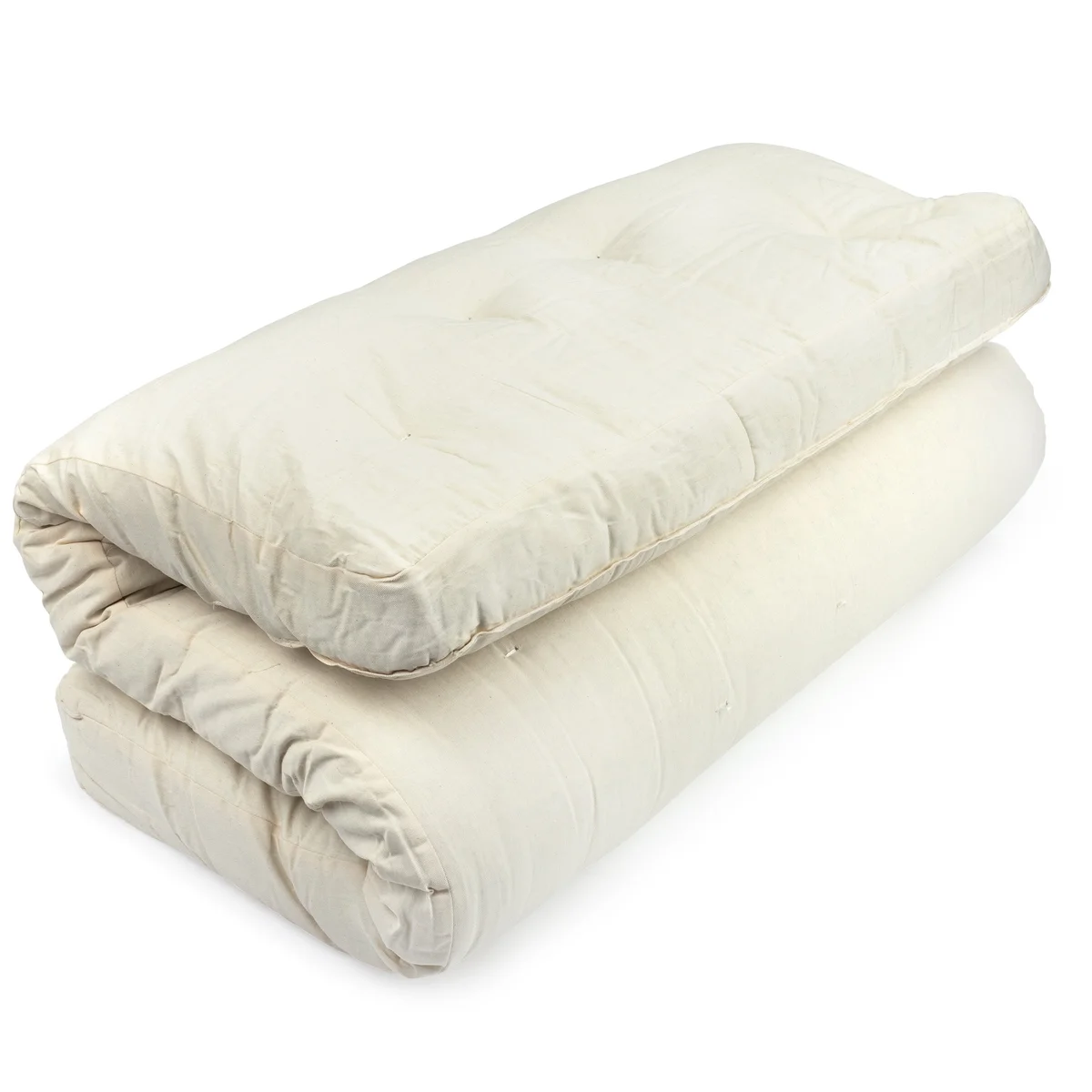
A shikibuton is a thin cotton or cotton-polyester pad, typically 2.5 to 5 inches thick, built to be folded away daily and aired, not to behave like an innerspring or a thick foam core. It compresses in the hip and shoulder zones over time rather than pushing back the way springs or latex do. On tatami the subfloor itself has a little give. On hardwood, concrete or slatted bed bases there is none. That changes how your body loads the surface.
The FULI King shikibuton is 2.5 inches of polyester batting with a cotton outer, rated 7/10. The MAXYOYO 6-inch is engineered thicker for buyers who want more cushion but still want to sleep near the floor. The Futon Shop's Natural Wool and Organic Cotton Shiki is rated 4/10 soft and will feel different again. When reviewers call a shikibuton "supportive" or "spine-aligning," they are describing what back and stomach sleepers of moderate weight feel on a firm flat surface. That is a specific case, not a general endorsement.
Do Japanese people have less back pain because they sleep on futons?
This is the central claim in a lot of floor-sleeping marketing, and the epidemiology does not support it. Fujii and Matsudaira invited 1,063,083 Japanese adults aged 20 to 79 to an online survey and analyzed 65,496 responses in the European Spine Journal. Lifetime prevalence of low back pain was 83%, with a 4-week prevalence of 36% (European Spine Journal). US adult lifetime prevalence estimates sit in a similar range. If daily futon use conferred a clinically meaningful spine advantage, something would likely show up at that sample size. It does not.
The honest explanation of why Japanese households sleep on futons is practical. A futon folds into the oshiire closet during the day, which matters in a country with small apartments. Tatami, oshiire and the futon together form a housing ecology that dates to the Edo period (Japanese Taste, Voyapon). It is about space and tradition, not a national spine treatment.
Who is most likely to feel better on a Japanese floor mattress?
Three profiles have the clearest biomechanical case. Back sleepers of light to moderate weight whose current mattress is old, soft or sagging, and who are losing their lumbar support into a dip, often improve when they move to a flat firm surface. Stomach sleepers, who already need a flatter surface to prevent the hips from sinking and the lower back from hyperextending, usually tolerate firm well. Sleepers under about 160 pounds who adapt within the first two to three weeks are the third group.
For these buyers, a 3 to 4-inch cotton shikibuton in the 6 to 8/10 firmness range can restore flat, supportive posture. The J-Life Shikifuton with Removable Cover is a handmade all-cotton build with a washable cover, firm at 6/10 and 4 inches thick. Luxton Home's Queen Long shiki and FULI's Premium Wavy Foam Core are both in the medium-firm zone relevant to this group. People who were already happy on a medium-firm Western bed often adapt to these. People who need medium-soft for pressure relief usually will not.
Who should not sleep on a Japanese floor mattress?
Side sleepers with hip or shoulder issues. On your side you load 60 to 70% of your bodyweight through two narrow points. Firm surfaces do not let those points sink, which concentrates pressure right where the pain is. Mattress clinicians recommend medium or medium-soft, roughly 5 to 6.5/10, for most side sleepers (Amerisleep). A 2.5 to 3-inch shikibuton on hardwood is the wrong tool for that body type.
Adults with osteoporosis or significant arthritis. Low bone density, a hard surface and the repeated act of lowering to and rising from the floor combine badly. The National Council on Aging recommends mattresses that make it easier to get in and out of bed for older adults with back pain (NCOA). A pad on the floor moves in the opposite direction.
People with pronounced lumbar lordosis. A hard flat surface flattens the natural curve of the lower back, leaving a gap the paraspinal muscles then have to hold through the night. Instead of resting, those muscles stay active, which is a classic mechanism by which a too-firm mattress worsens morning pain.
Pregnant sleepers past the first trimester, people who get up repeatedly at night (overnight caregivers, those with urinary urgency), and anyone recovering from hip or knee surgery. The floor is cold, the transitions are harder, and the lack of pressure relief on the side is unforgiving. If you fall into any of these groups, the evidence does not support switching for a back benefit.
Why did your back get worse after switching?
If you tried floor sleeping and your back feels worse, the usual culprits in rough order of likelihood:
Position mismatch. You are a side sleeper, your shoulder and hip have nowhere to sink, and you are compressing joints all night. A thicker pad like the MAXYOYO 6-inch or a latex and wool build like The Futon Shop's All Natural Latex and Wool at 6/10 can help. For some side sleepers the correct answer is simply not a shikibuton.
Lumbar bridging. On your back the curve of your lower spine hovers above a perfectly flat shikibuton. The erector spinae never fully relax. A thin lumbar roll, or a thicker lofted pad like The Futon Shop's 5-inch organic cotton model, can close that gap.
Break-in and body adaptation. Cotton shikibutons compress noticeably over the first two to three months. Your body is adjusting in the same window. Reviewers at TatamiShop and ComfortPure report typical sleeper adaptation inside two to three weeks and meaningful cotton compression inside two to three months. Judging in week one is judging the hardest version of the product with the least adjusted body.
Wrong floor. Tatami, hardwood and concrete feel very different under the same shikibuton. A pad that works on tatami can feel punishing on a cold concrete slab.
Unintended position shift. Many new floor sleepers unconsciously switch from side to back because the floor is uncomfortable on the side. That shift can irritate previously quiet conditions, including snoring, mild sleep apnea and some lumbar disc patterns.
Pre-existing condition. Facet joint arthrosis, sacroiliac dysfunction and late-stage lumbar disc disease are generally worse on very firm surfaces. If pain increased within a week of switching and did not plateau or improve over the next two to three weeks, stop and reassess.
If you still want to try, how do you stack the odds?
Match firmness to position. Back and stomach sleepers can tolerate 7 to 8/10. Side sleepers should aim for 5 to 6/10 and extra thickness, or skip the category. A 4-inch pad is a safer starting point than a 3-inch for most adults.
Give it three weeks of continuous use before judging. One night tells you nothing. Air it regularly: Healthline notes the importance of lifting the shikibuton off the floor to prevent mold from trapped sweat moisture, and sun-drying it periodically (Healthline). A compressed, damp pad is a worse pad.
Use the right pillow. On a flat surface the pillow is doing more alignment work than it does on a contouring mattress. Side sleepers need a thicker pillow to fill the shoulder-to-neck gap so the cervical spine stays neutral (BioMedical Engineering Online).
Buy an exit plan. A trifold or roll-up with a return window preserves optionality. J-Life, The Futon Shop and MAXYOYO publish varying return policies worth checking before ordering. The full ranking of models, with firmness, thickness and construction compared head to head, is at Best Japanese Floor Mattresses Ranked for 2026.
| Sleeper profile | Likely outcome on shikibuton | Shikibuton firmness zone |
|---|---|---|
| Back sleeper, under 160 lb, no joint issues | Often improves within 2 to 3 weeks | 6 to 8 out of 10, 3 to 4 inches |
| Stomach sleeper | Usually tolerates well | 6 to 7 out of 10, 3 to 4 inches |
| Side sleeper, no hip or shoulder pain | Mixed, often needs thicker pad | 5 to 6 out of 10, 4 to 6 inches |
| Side sleeper with hip or shoulder pain | Likely worse | Not recommended |
| Adult over 65 or with osteoporosis | Harder transitions, fracture risk | Not recommended |
| Pronounced lumbar lordosis | Often worse without a lumbar roll | Consider thicker medium-firm bed instead |
The short version
A Japanese floor mattress can be a reasonable choice for back and stomach sleepers under moderate weight who want a flat, firm, breathable surface and who commit to a few weeks of adaptation. It is not a research-backed treatment for back pain, and the Japanese population sleeping on futons does not show the lower back pain rates the marketing implies. If you need pressure relief on your side, have osteoporosis or arthritis, are older, or carry a pronounced lumbar curve, a medium-firm conventional mattress is the better-supported choice. If you want to try anyway, pick firmness to match your position, use a 4-inch pad rather than a 3-inch, allow three weeks, and keep your receipt.
See Best Japanese Floor Mattresses Ranked for 2026Questions people ask
Is sleeping on a floor mattress good for your back?+
Sometimes, for a specific person. Back and stomach sleepers under moderate weight whose current mattress is sagging often feel better on a firm flat surface. The strongest clinical evidence favors medium-firm beds rather than very firm or floor surfaces for chronic low back pain, so a shikibuton is not a general upgrade. It helps a subset of sleepers who already tolerate firmness.
Will a shikibuton help my lower back pain?+
It depends on sleep position, body weight and the current mattress. If you are a back or stomach sleeper on a sagging bed, a firm shikibuton like the J-Life or FULI can relieve pain by restoring flat support. If you are a side sleeper or carry hip or shoulder pain, a shikibuton typically makes it worse by concentrating pressure. No clinical trial has shown a shikibuton outperforming a medium-firm mattress for back pain.
Is floor sleeping better for your spine?+
Not inherently. A floor prevents your hips and shoulders from sinking into a sag, which helps if your current mattress is too soft. But a surface that is too hard flattens the natural lumbar curve and leaves the lower back unsupported. Medium-firm is what the systematic reviews recommend. The floor sits at the firmer end of what people tolerate.
Does a firm mattress help or hurt back pain?+
Both, depending on person and sleep position. The Kovacs 2003 trial with 313 adults found medium-firm outperformed firm on pain and disability over 90 days. Jacobson 2010 and Radwan 2015 reached the same conclusion. Very firm surfaces can relieve pain for back sleepers on soft, sagging beds, but they tend to worsen pain for side sleepers and for people whose lumbar curve is pronounced.
Who should not sleep on a Japanese floor mattress?+
Side sleepers with hip or shoulder pain, adults over 65, people with osteoporosis or significant arthritis, pregnant women past the first trimester, people recovering from hip or knee surgery, and anyone who gets up repeatedly at night. People with pronounced lumbar lordosis also tend to feel worse on a perfectly flat firm surface because the lower back muscles never fully relax.
Is there any science behind floor sleeping for back pain?+
The science supports medium-firm mattresses for chronic nonspecific low back pain, from Kovacs 2003 in The Lancet, Jacobson 2010 in Applied Ergonomics and the Radwan 2015 Sleep Health systematic review of 24 trials. None of these studies tested Japanese floor mattresses specifically. The biomechanical argument that firm flat surfaces promote neutral spinal alignment holds for some sleepers but is not evidence that floor sleeping beats a medium-firm bed.
Why do Japanese people sleep on the floor, is it healthier?+
Primarily because of housing and tradition. Futons fold into oshiire closets during the day, which is essential in small Japanese apartments, and tatami rooms are multi-use. The practice dates to the Edo period. It is not a health prescription. The Fujii and Matsudaira survey analyzing 65,496 Japanese adults in the European Spine Journal reported 83% lifetime prevalence of low back pain, in line with Western estimates.
I tried floor sleeping and my back got worse, why?+
Most often: you are a side sleeper and the firm flat surface is concentrating pressure on your hip and shoulder. Other common causes include lumbar bridging on your back, where the muscles never relax over the gap between the floor and your spine, judging too early before the cotton compresses and your body adapts, a cold hard floor (hardwood or concrete rather than tatami), and pre-existing facet joint or sacroiliac issues that firm surfaces tend to irritate. If pain did not improve within three weeks, revert to a medium-firm bed.
Sources
What this guide is based on. We research from published specifications, independent reviews and owner reports; we did not test these products ourselves.
- 1.Medium-firm mattresses best for low back pain (Kovacs trial press release), EurekAlert / The Lancet
- 2.Effect of different mattress designs on promoting sleep quality, pain reduction, and spinal alignment, Sleep Health: Journal of the National Sleep Foundation
- 3.What type of mattress should be chosen to avoid back pain and improve sleep quality? Review of the literature, Journal of Orthopaedics and Traumatology / PMC
- 4.Effect of prescribed sleep surfaces on back pain and sleep quality, Applied Ergonomics
- 5.Prevalence of low back pain and factors associated with chronic disabling back pain in Japan, European Spine Journal
- 6.Choosing the Best Mattress for Lower Back Pain, Spine-health
- 7.Best Mattress Type and Firmness for Side Sleepers, Amerisleep
- 8.Shikibuton: Benefits, Drawbacks and How To Use It, Healthline
- 9.The Japanese Futon: A Traditional Sleeping Experience, Japanese Taste
- 10.Why Do the Japanese Sleep on the Floor?, Voyapon
- 11.Shikibuton Break-In Guide: Timeline and Tips, ComfortPure
- 12.From Soft to Firm: Your Guide to Japanese Floor Sleeping Comfort Levels, TatamiShop
- 13.Spine alignment in men during lateral sleep position: experimental study and modeling, BioMedical Engineering Online
- 14.Best Mattresses for Older Adults With Back Pain, National Council on Aging
Products mentioned
 FULI Japanese Futon King Size WhiteFULI Premium Japanese Futon Bed Wavy Foam Core Queen
 J-Life Shikifuton with Removable CoverJ-Life Shikifuton with Shiruku Silk Snow Removable Cover
 Luxton Home Japanese Shiki Futon Queen Long
 MAXYOYO 6-Inch Extra Thick Japanese Floor Mattress Queen
 The Futon Shop All Natural Latex and Wool ShikibutonThe Futon Shop Natural Wool and Organic Cotton Shiki Futon
 The Futon Shop Traditional Organic Cotton Shiki Futon
More on japanese floor mattresses
Explainer
Shikibuton vs Futon: Why They Are Not the Same Product
The word futon covers two unrelated products in English: a 2 to 4 inch Japanese floor mattress and a 6 to 10 inch Western sofa bed. Here is how to tell them apart and buy the right one.
Explainer
Japanese Floor Mattresses and Mold: Why It Happens and What Prevents It
Mold under a shikibuton is not a product defect. It is condensation from body moisture meeting a sealed floor, and the traditional fold-and-air cycle is what prevents it. This guide explains the physics, the right surfaces, and the warning signs.
Buying guide
How to Choose a Japanese Floor Mattress: The Four Decisions That Actually Matter
Shikibuton thickness, fill material, airing routine, and 'Made in Japan' versus authentic construction: the four decisions that decide whether a Japanese floor mattress works for you.